
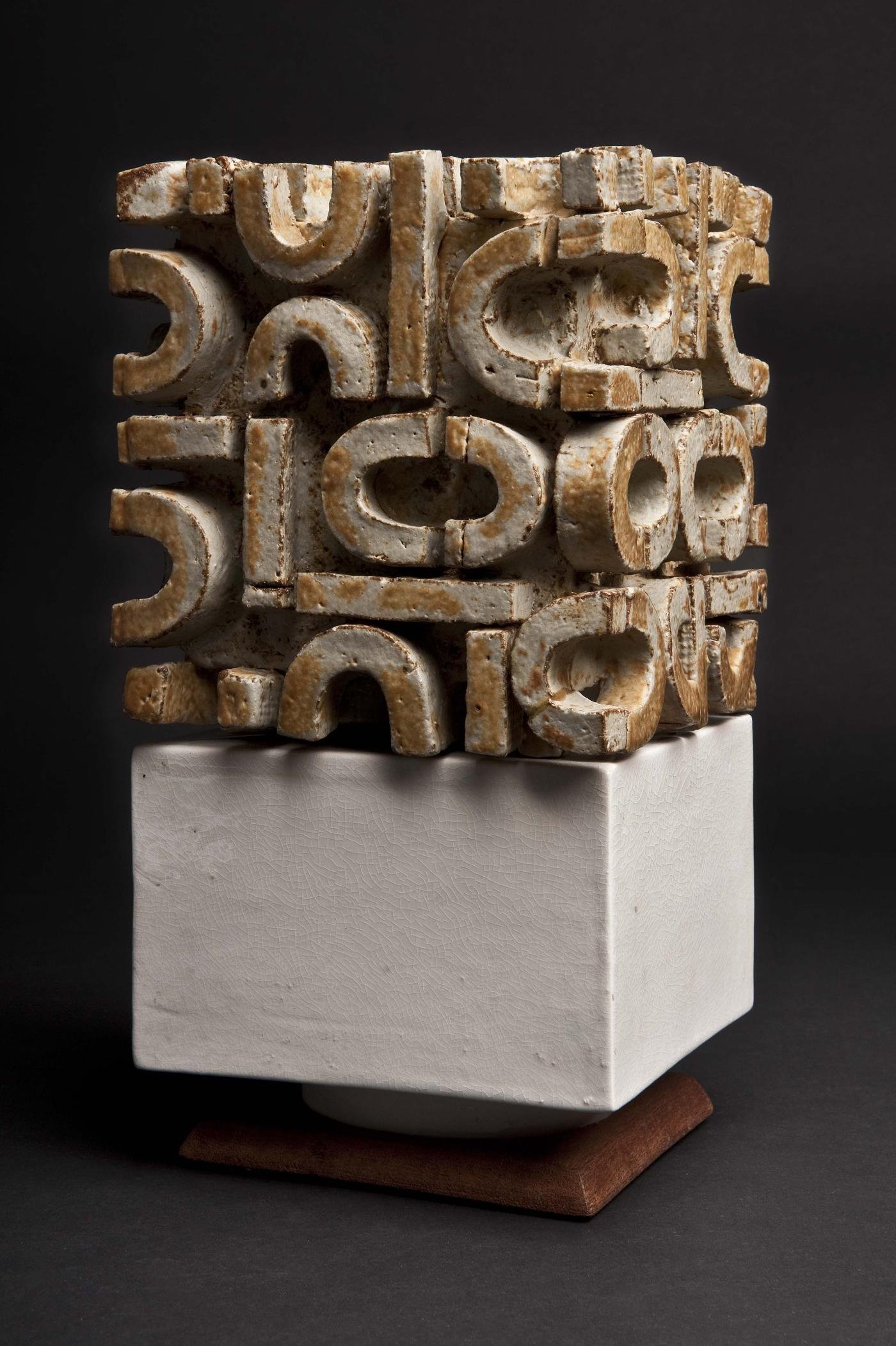
Like many visitors who come looking for art at Museum & Art Swindon, I am reasonably familiar with the 2D collection. I had not previously spent much time looking at the studio ceramics, but working with the team to install ‘Beneath the Surface’ has encouraged a far greater appreciation. When invited to choose an Item of the Month I could have happily have picked from quite a list. Ultimately though it was Ian Auld's ‘Architectural Form’ which I felt I particularly wanted to highlight.
This visually and technically interesting piece was made from slabs of flattened clay, which the artist cut, shaped and stuck together to build sculptural forms. That Auld (1926-2000) has set his bold and brutalist statement piece on a much smaller and simpler white plinth of delicate porcelain (look closely and you can see the crackle glaze) adds an extra layer of complexity and invites interpretation. The rise of the machine, perhaps, or grace under pressure.
To learn that Auld served as a naval radar operator in WW2 comes as no surprise: this work has an industrial, almost military feel to it, and before becoming a ceramicist he worked in woodblock, and this work almost resembles something he might have used in printmaking.
Perhaps it appeals to me partly because it’s not a pot, a vase or a teapot (although there are some lovely examples of all of those in this show) but because it’s a sculptural object, and a bit of a mystery as well. It looks a bit like an oversized Rubik's Cube, or maybe a Chinese puzzle box (does it open? I'm reliably informed it does not). For those of a certain age it might also bring back memories of something from Swindon’s past: the water feature which used to grace the Parade in our town centre. That work was installed in the year I was born and was certainly a favourite piece of public art when I was growing up in the 70s. It had internal lights as well as water flowing out of it. And a constant bloom of green algae, I seem to recall, which happily Auld’s work does not suffer from.

Image:The Cube by Geoffrey Wickham, c.1968, Photograph courtesy of Swindon Local Studies.
The sculptural aspect of Auld’s work is important. In the exhibition, ‘Architectural Form’ is placed in the section titled ‘Ceramics into Art’, which explores the intersection of ceramics, sculpture and painting in the postwar era. A pioneer of handbuilding techniques and influential teacher at the Camberwell School of Art, Auld was one of the artists who paved the way for a sculptural approach to studio ceramics.
By Miles Franklin, Curatorial Volunteer at Museum & Art Swindon
‘Beneath the Surface: A Century of Studio Ceramics in Britain’ is on display until 27 February 2027.
Main Image: ‘Architectural Form’ by Ian Auld (1926-2000), late 1950s-early 1960s, Stoneware with dry glazes and glossy white porcelain base, ©Museum & Art Swindon, Courtesy of the Estate of Ian Auld
