
When we first started planning Beneath the Surface we never imagined that we would be able to develop the collection at the same time as we were about to put on the first major exhibition of studio ceramics at Museum & Art Swindon. However, since we opened in 2024 we have seen a number of new acquisitions come into the collection, aspects of which are on display in the exhibition.
All of the new acquisitions are exciting, and help us tell more fully the story of studio ceramics in Britain from the 1920s until today, but I was particularly thrilled when we were contacted by the Art Fund to explore the possibility of a bequest of four pieces by the leading early studio ceramicist William Staite Murray (1881-1962). Swindon’s collection already contains a number of pieces from the very early days of studio ceramics in the form of our large collection of pieces by Katharine Pleydell-Bouverie, who lived nearby in Coleshill for the first half of her life. She was an early pupil of Bernard Leach, one of the people who shaped the course of studio ceramics in Britain in the 20th century. He was an advocate for functional, but beautiful, vessels, and many potters followed suit. However, Swindon’s collection is dominated by ceramics from the 1960s onwards, reflecting the collecting by Peter Burgess, head of ceramics at the Swindon School of Art. These pieces are often on the edge of functional, and the collection features many pieces that beyond functional or completely sculptural.
It was William Staite Murray who first put forward the idea that ceramics were art in the 1920s and 30s, when many artists were experimenting with abstraction. He identified himself as an artist who made pots, rather than as a craftsperson. He started making pottery during the First World War. He became a member of the Seven and Five Society, an organisation made up of seven painters and five sculptors, and was close friends with Ben Nicholson and Christopher Wood, who are also represented in Swindon’s collection. He said, ‘Pottery is pure art … pottery is plastic art in its most abstract essence.’
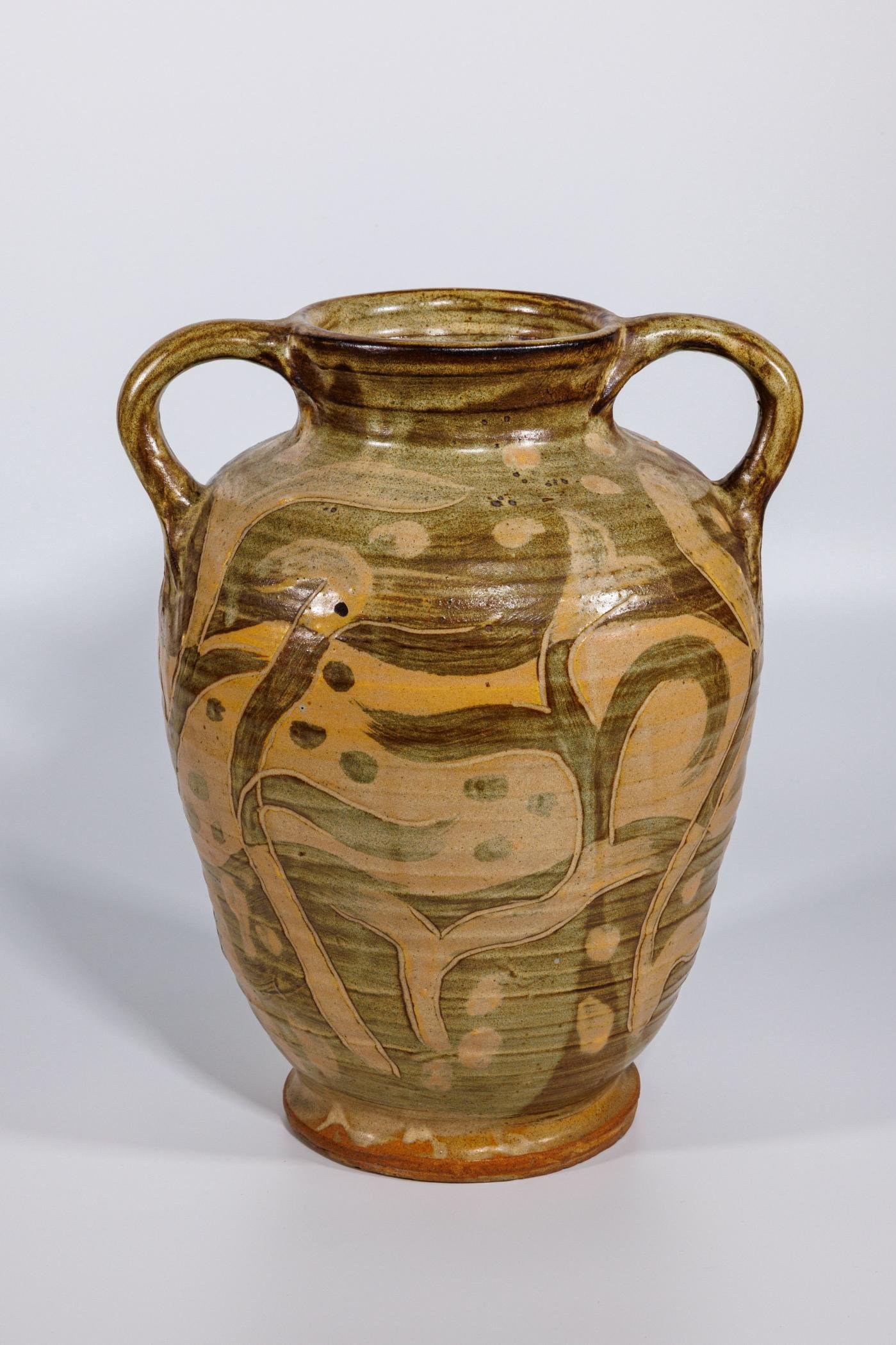
As well as creating forms, he was also interested in the idea of abstracted painting on pottery, and this piece by him shows bold mark marking that could be plant forms or animal forms or neither. It’s one of the boldest painted pieces by Staite Murray that I’ve seen. You can also see how it was made as Staite Murray has intentionally not smoothed out the rings that formed when the pot was thrown on the wheel. He was a Buddhist, one of the first to take up the practice in England, and for him the act of making and the creation of a piece was a ‘complete fusion of consciousness’.
This group of ceramics were a bequest from the late Ann Zwemmer, and came to her via her husband Desmond, who died in 2000. He was the son of the owner of the influential Zwemmer Gallery, Anton Zwemmer. The gallery promoted abstract art in the 1930s, including the final show of the Seven and Five Society in 1935, in which William Staite Murray took part. The 1935 show was the first entirely abstract exhibition to be held in Britain. By this time Desmond Zwemmer was already involved in the gallery, and knew many of the artists personally.
Staite Murray became the instructor in ceramics at the Royal College of Art in 1926, chosen over Bernard Leach, who had also applied for the role. He was an influential teacher, but in 1939 he travelled visit relatives in Zimbabwe and never returned to Britain or to making pottery. At the same time, in 1940, Bernard Leach published his hugely influential A Potter’s Book, and his theories became dominant. However, Staite Murray’s ceramics were rediscovered by new generations of ceramic artists wanting to break away from making functional vessels. Today he is recognised as one of the most important ceramicists and artists in Britain in the early 20th century.
by Kirsty Hartsiotis
Collections and Exhibitions Officer, Museum & Art Swindon
This vase and two others by William Staite Murray are currently on display in Beneath the Surface: A Century of Studio Ceramics in Britain (9 May 2026 – 27 February 2027).
Vase, 1930s, by William Staite Murray. Painted stoneware. Bequeathed by Ann Zwemmer with Art Fund support, 2026.
