
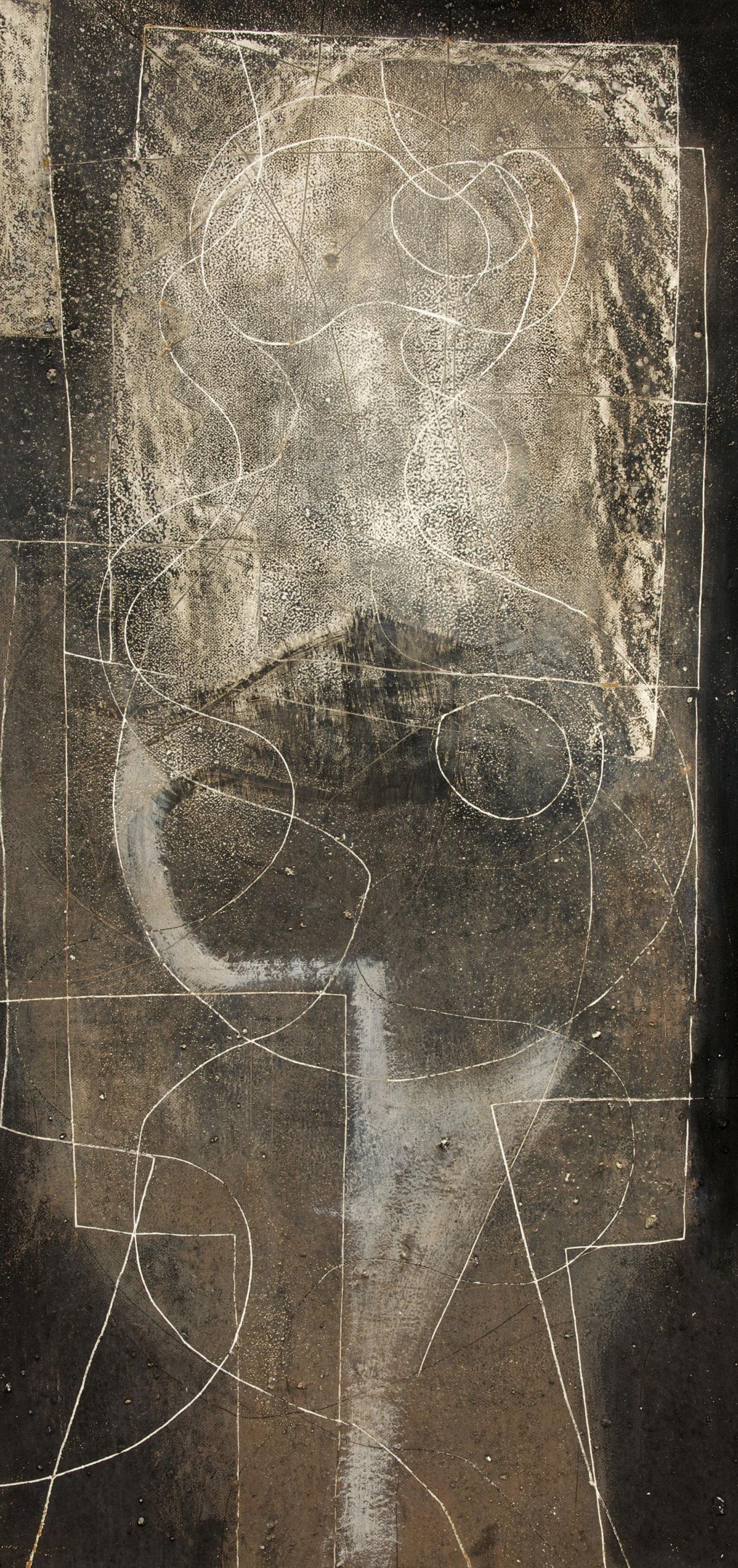
‘Composition in Black and White’ (1933) by Ben Nicholson (1903-1975)
Our volunteer Fay discusses Ben Nicholson’s seminal painting, currently on display in ‘Dialogues: Continuing Conversations from Beneath the Surface’.
As someone who does not come from an art background, being asked to select and write about an artwork was a daunting prospect. However, this was also an opportunity I jumped at. My involvement with ‘Dialogues’ marked my fourth art hang as a volunteer. (What a way to see so many pieces for the first time!) After working with the curators to install ‘Beneath the Surface: A Century of Studio Ceramics in Britain’, assisting with ‘Dialogues’ felt like a natural progression. The exhibitions respond to one another, showing the exchange of ideas across studio ceramics and two-dimensional art. This is nowhere more evident than in ‘Composition in Black and White’ by Ben Nicholson (1894-1982).
Nicholson was surrounded by artistic influences throughout his life, beginning with his upbringing and continuing into adulthood through his social circles. Most notably, his friendship with Paul Nash (1889-1946), and his marriage to Barbara Hepworth (1903-1975) proved to be key influences on his artwork. Nicholson and Hepworth travelled extensively, met other artists and became central to modern creative communities. They shared a studio in Hampstead before moving to St Ives in 1939.
Nicholson was inspired by Hepworth’s sculptures and the physicality of her work, something which he began to emulate within his own. This is clear to see in ‘Composition in Black and White’. One of the reasons I am so drawn to this work is the fact that it is so textural, with the surface of the canvas almost imitating that of a ceramic work. The abstract nature of the painting means that there is no evident subject matter to draw you in, yet the texture creates a sense of physical connection with the work. You can imagine what the surface feels like.
The intersection of the etched straight, geometric lines with softer curves, along with the black and white colour palette suggests a push and pull between abstraction and figuration. This takes on new meaning given the year that ‘Composition in Black and White’ was created. In 1933, Nicholson began to shift his artistic style towards abstraction, a transition which is evident within the painting. This demonstrates his keen awareness of the potential of modern art, and particularly the dawn of abstract art – a movement in which he held great influence. It is clear that his interactions with so many other artists left him perfectly attuned to the changing tides of modernism. The etched white lines and shapes cut through the black surface of the painting, perhaps signifying the future of modern art breaking through the surface.
Fay Batten
Curatorial Volunteer at Museum & Art Swindon
Image credit: ‘Composition in Black and White’ (1933) by Ben Nicholson, Oil and gesso on board, Museum & Art Swindon, ©Estate of Ben Nicholson
