
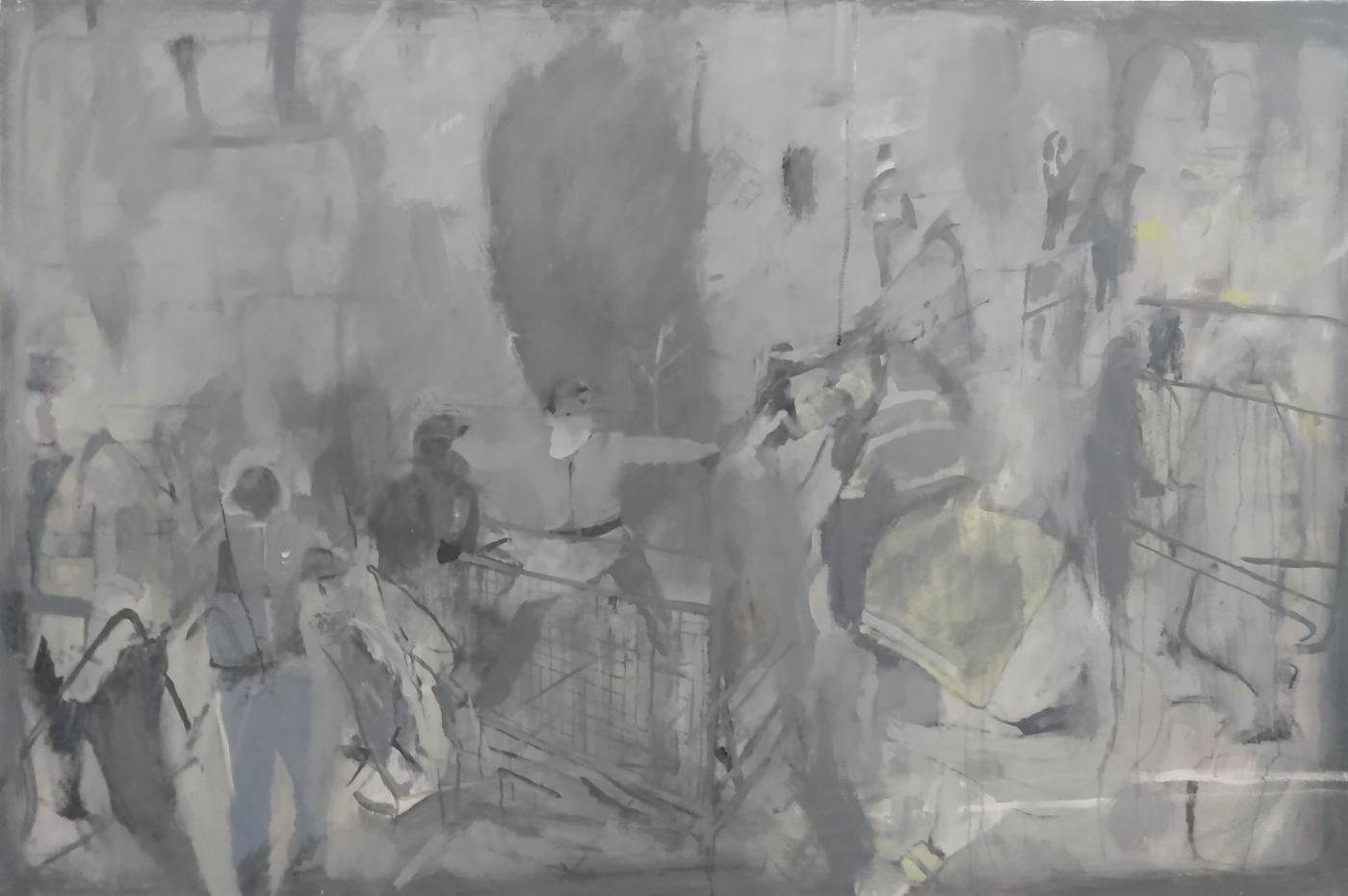
When I was helping the curatorial team hang Art Unpacked, Sally Payen’s painting titled ‘He had to run to save himself from oblivion, yet through running he forgets himself’ was one of the artworks which stood out to me, and not just because of its large size. Initially thinking it an abstract, I slowly started seeing figures emerge from the haze – or is it tear gas? – and a previously static scene became animated.
In shades of grey we have a group of protestors, and picked out in yellow are the hi-vis jackets of the police and the flanks and gaiters of a police horse. One protestor’s face is blank, framed by a hoody, which at the time this was painted (2020) was a disparaging term often used by some to describe the disaffected youth. The central figure looks poised to throw something and reminds me of Banksy’s famous work Love is in the Air. The protestor in that work is about to lob a bunch of flowers: here the projectile is unclear, but the mood suggests it is almost certainly not botanical.
Of this work Sally Payen told Museum & Art Swindon that at the time she was “interested in the push and pull of democracy” and how photographs of street conflicts look a lot like the paintings of war which hang on many a gallery wall. At 1.5 metres wide, the size of Payen’s painting reflects those historic battle scenes. She painted this towards the end of a long period during which she was painting scenes of civil unrest in various towns and cities around the UK. A series of works under the title ‘Fence and Shadow’ were based around the Greenham Common nuclear weapon protests, but more recently she has painted pastoral scenes.
As well as appreciating the way the painting makes you work for a while to pick everything out, I also enjoy its title! I like a long, perhaps slightly esoteric title, and this one fits the bill. ‘He had to run to save himself from oblivion, yet through running he forgets himself’. No-one I can see in the painting is running or saving themselves, it seems to me to be a stand-off. Oblivion though, is presumably represented by the great void in the background. The future perhaps.
Intrigued by that title I turned to Google. “The piece explores themes of psychological escape, survival, and the paradoxical nature of running”, it told me. “The physical act of running brings about a meditative, consuming state where the runner completely loses their sense of self”. To me this scene seems anything but meditative, but that’s what AI thinks, and AI is never wrong, is it?
By Miles Franklin
Curatorial Volunteer at Museum & Art Swindon
Image credit: ‘He had to run to save himself from oblivion, yet through running he forgets himself’ (2020) by Sally Payen, Museum & Art Swindon, ©Sally Payen
