
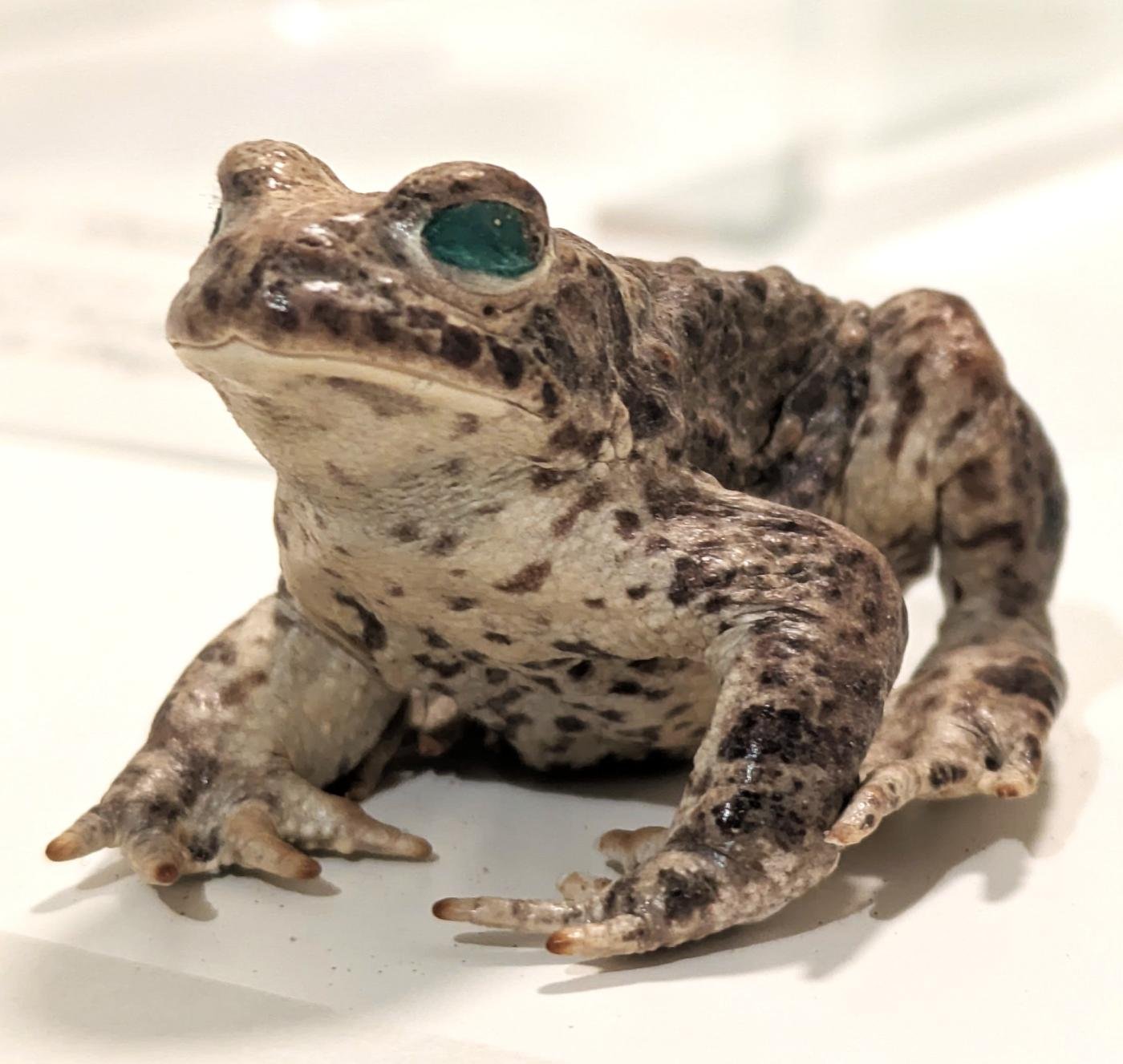
Taxidermy was a serious hobby in Victorian Britain. Unprecedented advances in science and technology meant that the study of natural history and zoology became more accessible. This in turn helped to fuel a mania for the collection and preservation of animals, many of which ended up in the hands of public museums. Even now, stuffed and preserved animals make up a sizeable portion of many museums’ collections, and Museum and Art Swindon is no exception. Alongside the famous gharial, there is a collection of smaller creatures on display, including a lapwing, a hedgehog and a brown rat.
One of the most interesting examples of taxidermy in the collection is the natterjack toad (Epidalea calamita), a small amphibian distinguishable from the common toad by the yellow stripe that runs down its back, and by its inability to hop (one of its vernacular names is ‘running toad’). The natterjack is an endangered species in the UK and its range is limited to a handful of coastal and heathland habitats. Pollution, mismanagement of coastal ecosystems, human overpopulation and farming have all contributed to its decline, and it is now a protected species here and in parts of Europe.
The natterjack has a colourful history, and its links to witchcraft and the occult make it an apt subject at this time of year. Toads have long been associated with witches, both as familiars and as something to put in the cauldron to give a spell some extra spice. The natterjack has a particularly important place in magical lore. In parts of the UK it was once believed that a ‘toad bone’ could give its owner power over horses: all you had to do was place a live natterjack in a copper pot with holes in it, bury the pot in an anthill, wait for the ants to eat the toad’s flesh, drop the toad’s skeleton in running water and watch for the bone that floated upstream. This was your toad bone.
Other practices included ‘milking’ the toad for its venom (which it excretes through its skin and from the parotid glands which, uniquely, are external and located at the top of the head), and extracting the ‘toadstone’, a stone with healing properties believed to lie within the natterjack’s skull.
While the magical properties of toads might seem fanciful, they may have some scientific basis. A natterjack’s venom contains bufotenin, a substance which in concentrated doses has a psychoactive effect, while ongoing scientific research suggests that it also has antiviral properties. Of course, the natterjack at MAS has long since lost his venom, but we like to keep him locked in his display case at this time of year, just to be on the safe side…
By Thomas Blake
Visitor Engagement Officer , Museum & Art Swindon


Top: The taxidermy natterjack toad on display at Museum & Art Swindon
Bottom: A natterjack toad in the wild (Photo by Christian Fischer, wikimedia commons)
