
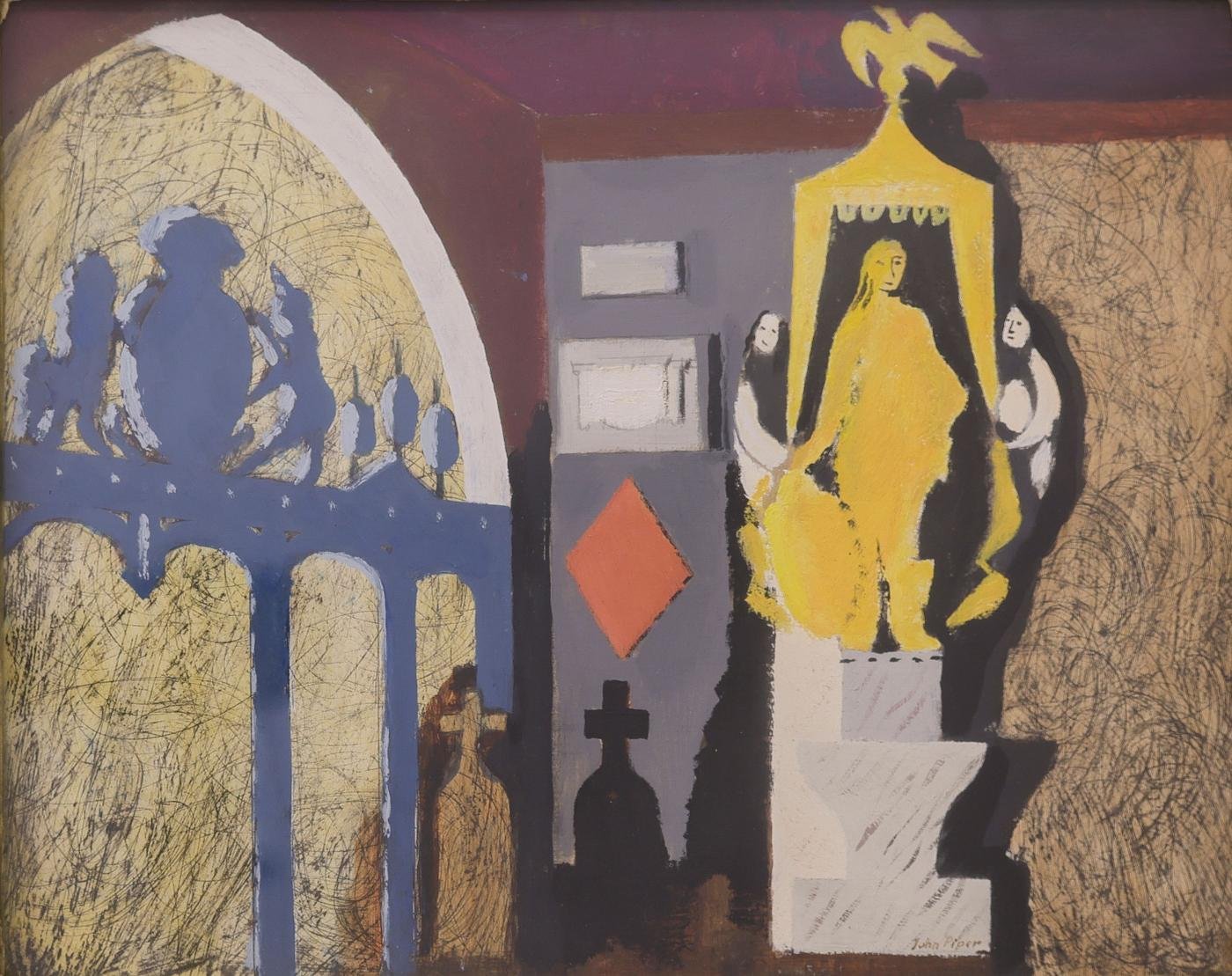
This August we’re celebrating ‘John Piper in the South Country’ with a deep dive into ‘Bolingbroke at Lydiard Tregoze’, 1940.
During his lifetime, John Piper (1903-1992) was one of Britain’s best-known artists. His career coincided with a period of great upheaval within the art establishment. In the 1930s, when Piper’s work first began to attract public interest, modernism was the buzzword and there was much debate regarding the comparative values of figurative and abstract art. It was a time of heated opinions, polarisation and the formation of numerous (and often vociferous) artistic movements. Piper joined one such movement – Ben Nicholson’s Seven and Five Society – in the early 1930s, seemingly nailing his flag to the mast of abstraction and experimentation. But his relationship with the trends and currents of British art was complex and often uneasy; his brand of modernism reached back to older forms and his subjects were often pastoral, architectural prehistoric or ecclesiastical.
Bolingbroke at Lydiard Tregoze was painted in 1940, just after Piper’s conversion to Anglicanism, in the year that he became an official war artist. It is a great example of his preoccupation with religion and the built environment. It also shows how he walked a delicate line between modern and traditional forms. The blocky use of colour, the scratchy backgrounds and the playful perspective all point towards abstraction, but the subject is figurative and entirely recognisable. It shows a monument known as ‘The Golden Cavalier’ which depicts Edward St John, who was killed at the second Battle of Newbury in 1645 while fighting for the Royalist cause in the English Civil War. The painting’s title is a misnomer: Piper believed that it showed another member of the St John family, Henry, 1st Viscount Bolingbroke (1678-1751).
In Bolingbroke Piper employs a characteristic palette of primary colours, black and white. It is worth comparing with one of his most famous paintings, Interior of Coventry Cathedral, completed later the same year. The use of colour and the presentation of architectural elements create a near-perfect visual rhyme between the two works: the yellow on the right, the combination of red and grey in the centre, the arches on the left, the use of black throughout which gives a golden, luminous energy to the yellows. The two paintings’ similarities (and subtle differences) give a valuable insight into Piper’s methodology, making it clear that he thought and painted along thematic lines and possessed a distinct and keenly developed personal style.
After the war, Piper broadened his practice considerably, working with stained glass, textiles and ceramics. He designed dust jackets for books, sets for operas, plates for Wedgewood, and even the firework display for the 1977 Silver Jubilee. He was much in demand for large-scale public works, and his commissions included the Crown of Glass in Liverpool’s Metropolitan Cathedral, Chichester Cathedral’s high altar tapestry and the mosaic in the BBC Television Centre. But despite establishment acceptance and widespread popularity, he never lost his instinct for experimentation and was producing innovative and highly expressive work well into his eighties. He died in his rural Buckinghamshire home in 1992.
By Thomas Blake,
Visitor Experience Assistant at Museum & Art Swindon
‘Bolingbroke at Lydiard Tregoze’ (1940) is from the collection at Lydiard House Museum. It is on display in ‘John Piper in the South Country’ at Museum & Art Swindon until 26 September 2026.
Image Credit: ‘Bolingbroke at Lydiard Tregoze’ (1940) by John Piper, Lydiard House Museum, © the Piper Estate /2026 DACS.
