
John Maltby (1936-2020) was a key figure in twentieth century British ceramic art. He was born in Cleethorpes, Lincolnshire, at a time when the town was at the heart of the fishing industry. His father was a fish merchant, and the memory of boats and the sea played an important role in Maltby’s practice throughout his career. As his art developed, his influences expanded to include travel, architecture and abstract art.
Like many studio potters of the era he was inspired – and to some degree mentored – by Bernard Leach (1887-1979), the leading figure in British studio ceramics. As a result, much of his early work bore the hallmarks of Leach’s style, which was heavily influenced by raku ware, the traditional Japanese pottery used in tea ceremonies. Later, after time spent teaching at a private school in Surrey and working as an apprentice to Leach’s son David, he set up his own studio in Devon where he began to develop his unique and idiosyncratic style. As well as the nautical themes inspired by his childhood, Maltby used his pottery to engage with ecclesiastical and humanistic ideas. Many of his pieces featured human figures, often in groups of three. Sometimes these figures were on boats, sometimes standing outside buildings or famous landmarks.
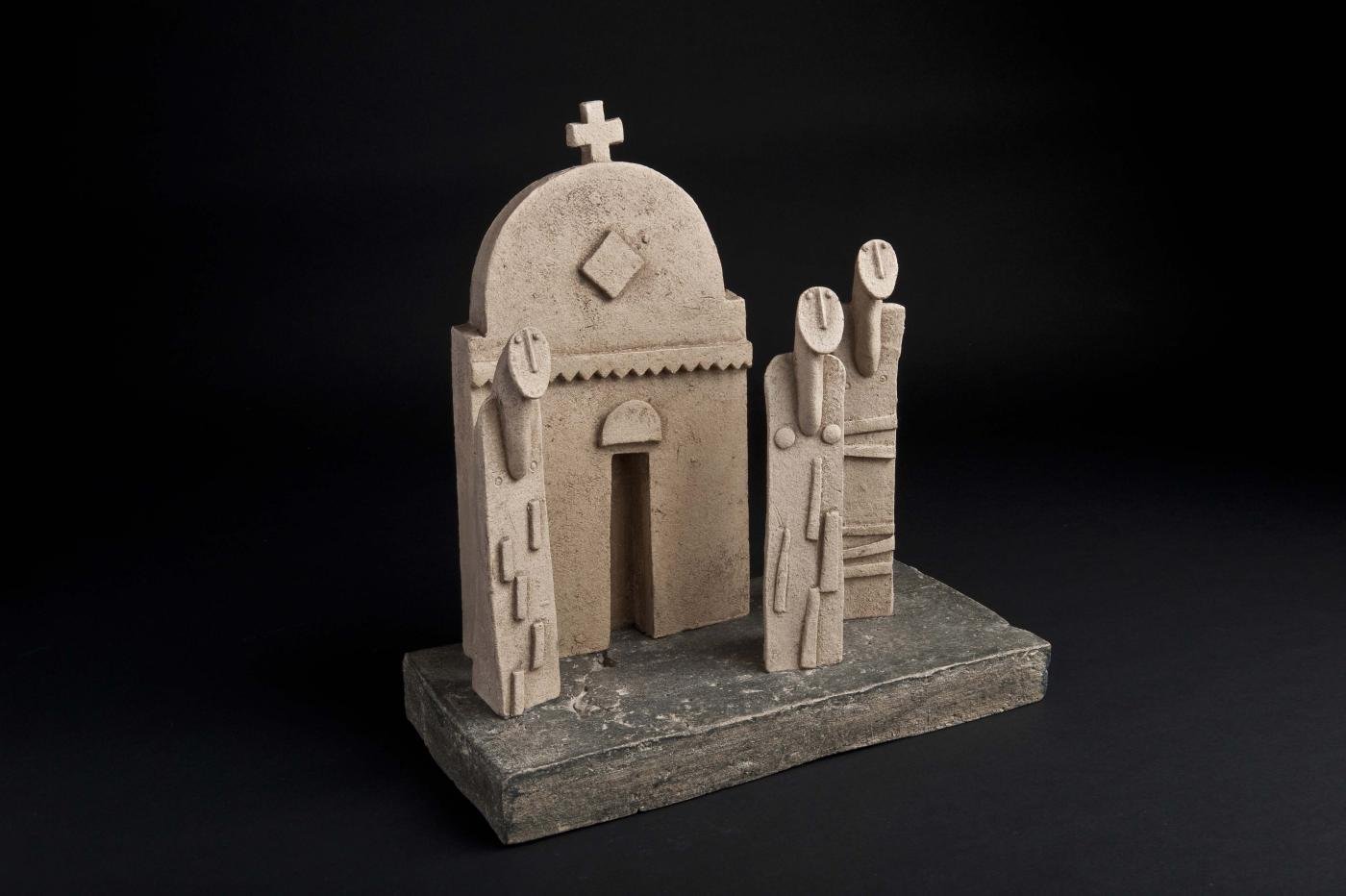
‘Sightseers (Greece)’ was created in 2006. It depicts three people and a building that appears to be a Greek orthodox church, perhaps one of the famous domed churches of Santorini. The piece is typical of Maltby’s late style: the subject is clearly portrayed but nonetheless ambiguous. Despite the title, the three human figures are not looking at the church; instead they stare out towards the viewer. In this way, an apparently simple piece of ceramic art subtly comments on the complex three-way relationship between the artist, his subject and his audience. It also hints at changing attitudes towards religion and spirituality, where a sacred space becomes a tourist attraction. Sightseers at first appears to be earthy and robust, perhaps inspired by Maltby’s love of untutored artists like Alfred Wallis. But the three human figures – especially their faces – are delicate and enigmatic, and while the building’s simplicity could be construed as naïve, Maltby’s skilled hand makes it seem almost classical.
Maltby’s work was widely acclaimed during his lifetime, and was represented in the Victoria and Albert Museum as well as public collections in Italy and Germany. He was also extremely prolific and anti-elitist: his high output was in part a deliberate ploy to keep his prices low and his art affordable. John Maltby continued working into his eighties. After undergoing major heart surgery in 1996, he was no longer able to create large pieces from clay, and instead concentrated on small sculptures and decorative items. When he died in 2020 he left a rich and varied legacy, and a reputation as a central figure in the golden age of British ceramics.
By Thomas Blake, Visitor Experience Assistant
‘Sightseers (Greece)’ is currently on display in the Origins Galleries, along with other studio ceramics from the collection at Museum & Art Swindon.
(Image: Sightseers (Greece), 2006, by John Maltby, ©Estate of John Maltby, Donated by Mike Yates, 2014)
