
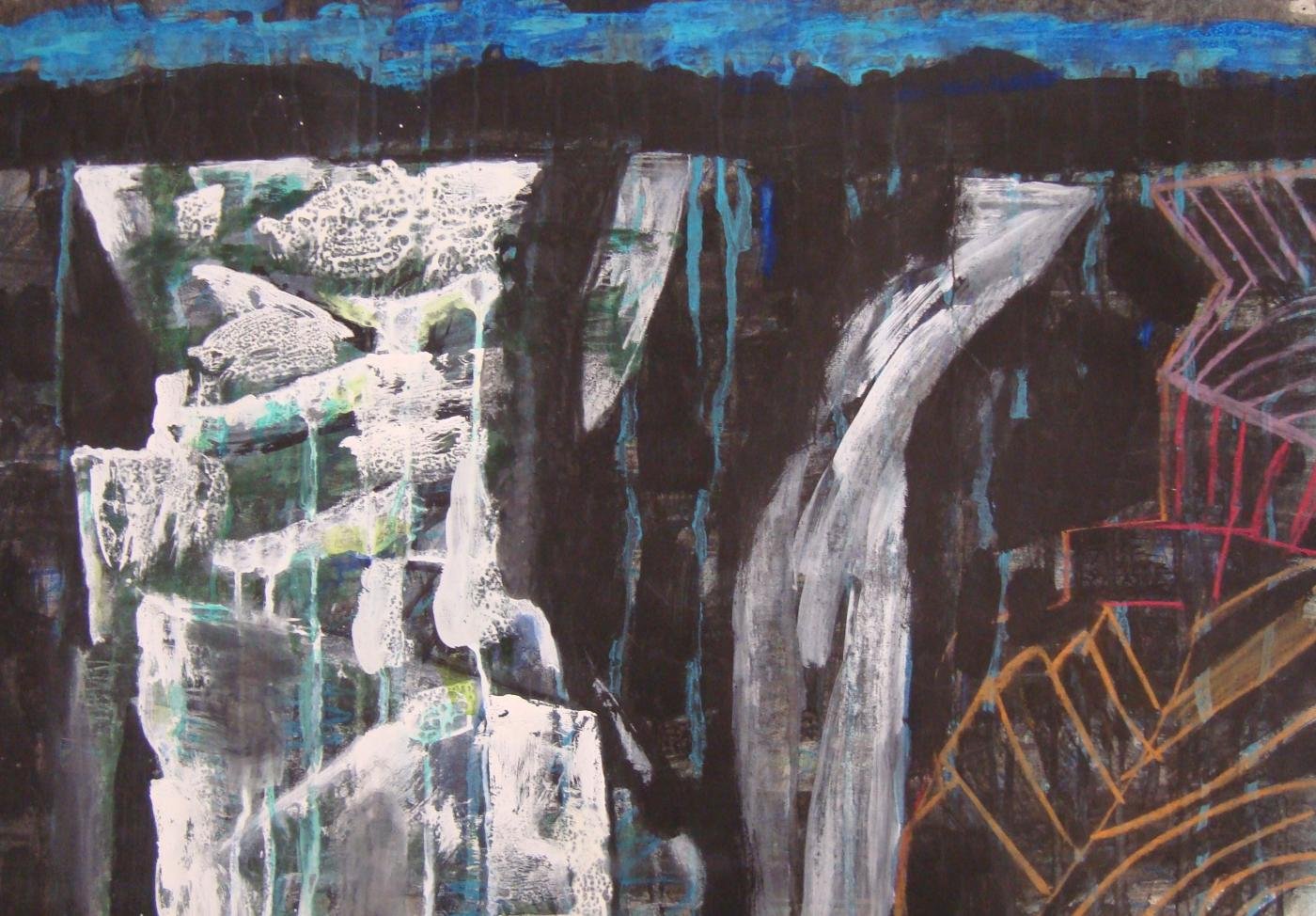
This month our volunteer curator Tayebeh gives her perspective on Roy Bizley’s Untitled (Icelandic Landscape).
This painting looks abstract and maybe even strange at first, but in a deeper way it shows the strong forces of nature and the deep feelings inside humans. Iceland in this artwork is not only a place; it is a symbol of ice and fire existing together. It represents calm and violence, silence and sudden change, cold and heat. The artist chose Iceland because nature there is still wild and powerful, just like life, which is never fully safe or predictable. The painting is not created to be a beautiful landscape. Instead, it wants the viewer to slow down, feel a bit uncertain, and start asking questions. This is the moment when art begins—when there is no easy answer.
The colourful lines in pink, red, and orange look like spider webs, and they show hidden energy under the ground, like lava and pressure that has not exploded yet. They also look like veins or nerves, as if everything in this world is connected. Their bright colours inside the dark background are a warning that the calm surface is not completely safe. The blue water represents time, memory, and the ongoing flow of life. It reminds us that nothing stays the same, and even ice will eventually melt or change. The broken pieces of ice symbolize frozen feelings or memories that seem still, yet they are starting to crack, showing that even the quiet parts of us are alive and moving. The dark and black areas around the painting stand for the unknown, for fear, and for the deep parts of the human mind that we do not always want to look at. The artist keeps the space dark so that the viewer does not feel completely comfortable, because the truth is not always easy to face.
A normal eye might only see colour and shape, but an artist sees pressure, tension, slow movement, and a moment right before something breaks or becomes new. This painting is about that exact moment: the moment before collapse or rebirth. Similar ideas exist in Iranian art as well. Artists like Mahmoud Javadipour, Mansour Ghandriz, and others in modern abstract Iranian painting also explore tension, layers, darkness, and deep emotional energy. This shows that the language of this artwork is not only Icelandic; it is universal. The painting reminds us that the world, just like humans, is made of both ice and fire—calm and violent, bright and dark—and if we look only at the surface, we miss the deeper truth.
-Tayebeh
Untitled (Icelandic Landscape) is currently on display in ‘The Human Experience: Reflections on Swindon’s Art Collection’, until 5 June 2026. The exhibition was curated by volunteers from Multaka-Swindon. ‘Multaka’ translates from Arabic to English as “meeting point”. It is about people from different backgrounds and cultures coming together to share ideas. Personal and cultural perspectives are woven into the exhibition, but the themes explored are part of the universal human experience.
